Run Gordon Pass at first light this season and you will still do what every Port Royal and Aqualane Shores boater has done for years: hug close to the green marker, watch the water go pale where it should stay dark, and trust the line you learned last winter more than the chart in front of you. That habit exists for a reason. The pass has silted in on a predictable rhythm for as long as most residents have kept a boat here, and the fix has always looked the same. Dredge it, restore the depth, wait for the sand to come back.
This time the fix looks different. The Army Corps of Engineers didn't just contract another pass through the same channel. It built something into the channel that wasn't there before, and that distinction matters more to daily boating life at the foot of Port Royal and Aqualane Shores than almost anything else happening in Naples this year.
A Channel With a Short Memory
Gordon Pass has a documented habit of drifting. Boaters who ran the cut in the winter of 2018 into 2019 found both channel markers, designated G1 and R2, had shifted south of their charted position, with water depths as shallow as five feet in the middle of what should have been the marked channel. A dredge cycle in 2021 restored the pass to roughly eight feet at its shallowest points, enough for most vessels that call Port Royal and Aqualane Shores home. But eight feet after a dredge and eight feet three years later are two different promises. The pass doesn't hold its depth. It borrows it, and the loan comes due.
That pattern is why Gordon Pass carries a different kind of respect among people who actually live on it than it does among visitors reading a cruising guide. It is the most reliable route in and out of Naples Bay, wider and better marked than Doctors Pass to the north, which shoals in faster and gets a smaller share of federal attention because it carries a fraction of the traffic. Gordon Pass is Naples' front door. Doctors Pass is the side entrance nobody widens. But a front door that needs rehanging every few years is still a front door with a problem, and everyone who has idled through the outer bar on a falling tide already knows it.
What the Corps Actually Contracted This Time
On September 2, 2025, the Army Corps of Engineers' Jacksonville District awarded a maintenance dredging contract worth just over $3 million to Southwind Construction Corp., a firm based in Evansville, Indiana, for the federal navigation channel that runs from Naples to Big Marco Pass. The scope covers Gordon Pass cuts one through seven. That part is routine. What isn't routine is the second half of the job specification: a new, one hundred foot wide settling basin built to run the length of the Entrance Channel.
A settling basin is not a bigger dredge. It's a purpose built pocket in the channel bed designed to catch sediment before it piles up in the water boats actually use. Instead of the pass filling evenly across its width and forcing a full recut every few years, the basin is meant to collect the sand that would otherwise settle in the traveled channel, buying the pass more time between maintenance cycles. It's the difference between repaving a road every time it cracks and regrading the ground underneath so it cracks less often.
The quick specifics, for anyone who wants the paper trail:
- Contract awarded: September 2, 2025, to Southwind Construction Corp.
- Contract value: approximately $3.05 million
- Scope: maintenance dredging of Gordon Pass cuts 1 through 7, plus a new 100-foot-wide settling basin along the Entrance Channel
- Funding source: federal disaster relief supplemental appropriations
- Construction window: expected to begin November 2025
That last line matters for timing. The work moved through the 2025 to 2026 dredging season, which means the boaters who spent last winter running the pass were running it while the settling basin was actively being built underneath them.
Where the Sand Actually Goes
The material coming out of the channel doesn't disappear. Roughly 65,000 cubic yards of beach compatible sand from this project is being placed on Keewaydin Island, starting about 300 feet south of the pass and extending roughly 4,000 feet down the shoreline. For anyone who anchors off Keewaydin on a Sunday or beaches a boat there for lunch, that's the same sand that keeps the island from eroding into the pass it borders.
Humiston & Moore, the coastal engineering firm that has worked with the Corps on permitting and placement for this stretch of shoreline, has described the goal in plainer terms than most agency language allows: a system where future sand placement on north Keewaydin Island continues to move south, but in a more controlled way that keeps pace with how the inlet is actually managed. The firm has also reported that sea turtle activity on the island has improved under this approach, with shorebird activity holding steady, which tells you the fix was built to work with the island's ecology rather than around it.
Why the Front Door Matters More Here Than Anywhere Else
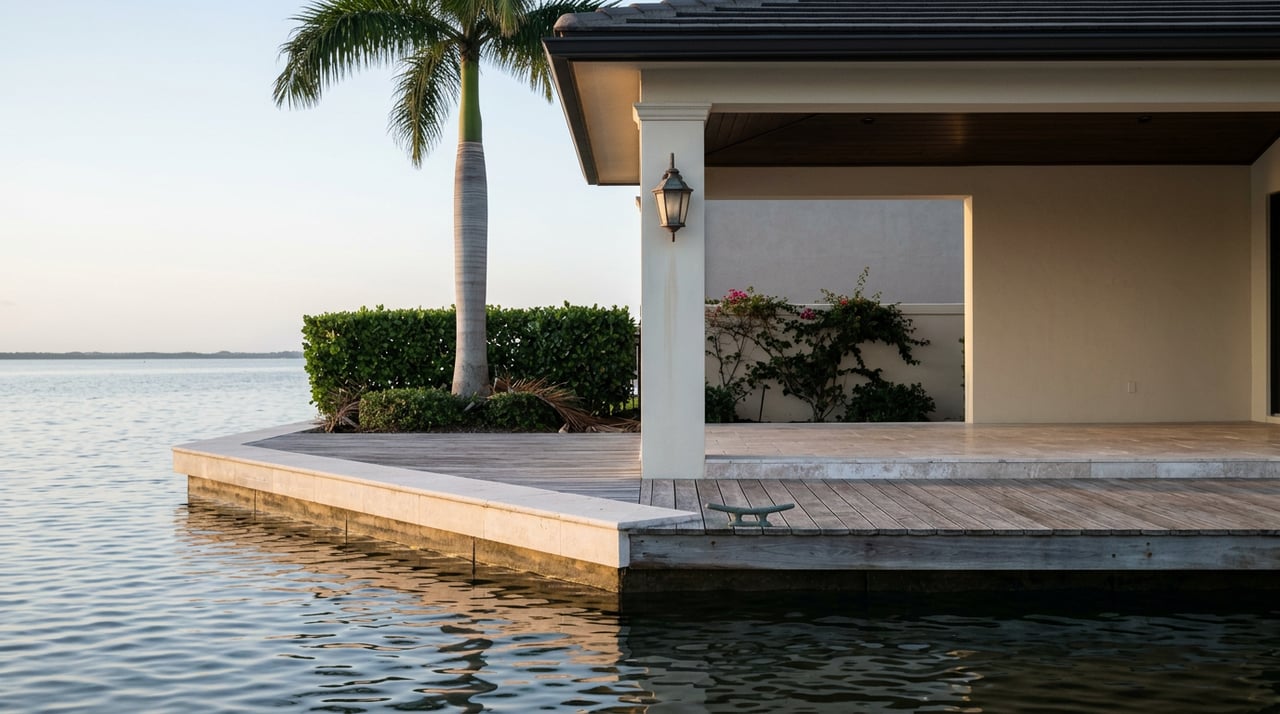
Every neighborhood along Naples Bay benefits from a well kept Gordon Pass. But Port Royal and Aqualane Shores sit closest to it, and the absence of any bridge between these deep water canals and the open Gulf is one of the defining facts of daily life in both neighborhoods. No fixed bridge means no clearance limits and no tide timed openings for anyone running a serious sportfisher or a larger cruiser straight out to the water. That advantage only holds if the pass itself stays passable, and passable is exactly what a settling basin is designed to protect over the long run rather than reset every few winters.
Compare that to Doctors Pass, which connects Moorings Bay to the Gulf between the Moorings and Park Shore. It's narrower, shallower, and shoals in more readily, and it simply doesn't receive the same dredging priority because it carries a fraction of the traffic Gordon Pass does. That's not neglect. It's a reflection of how the Corps allocates a finite maintenance budget across a coastline with more passes than dollars. Gordon Pass gets the settling basin because Gordon Pass is the route the region actually depends on.
The Season Ahead
Naples Bay gets busiest from November through April, when transient slips at the City Dock fill fast enough that the seven day limit on stays there rarely feels like the binding constraint. That same window overlaps almost exactly with Florida's seasonal manatee protection period, which typically runs from November 15 through March 31 as manatees move into warmer, shallower water and speed zones tighten across the bay and its connecting waterways. Boaters running Gordon Pass this fall and winter are working through both realities at once: a channel that just had real engineering work done underneath it, and a season where slow speed compliance near docks, seawalls, and canal mouths matters as much as it ever has for keeping the bay's manatee population safe.
None of that changes the daily habits that make running the pass second nature to people who live here. Watch the water color. Trust the markers, but check them against a recent chart rather than last year's memory. Give the outer bar room on a hard falling tide. What has changed is what's underneath that habit. For the first time in a maintenance cycle that residents have watched repeat since at least 2018, the fix wasn't just another dredge. It was a decision to change how the pass refills at all, which is a different kind of promise than the ones this channel has kept before.
That's the sort of local detail that doesn't show up on a listing sheet, and it's exactly the kind of thing worth knowing if this stretch of water is part of your daily life rather than a line on a chart. If you're weighing a move onto Gordon Pass, or you already call Port Royal or Aqualane Shores home and want a conversation about what's actually happening in this market, The Kim Price Group would be glad to talk it through. Work With Kim — Request a Private Consultation.