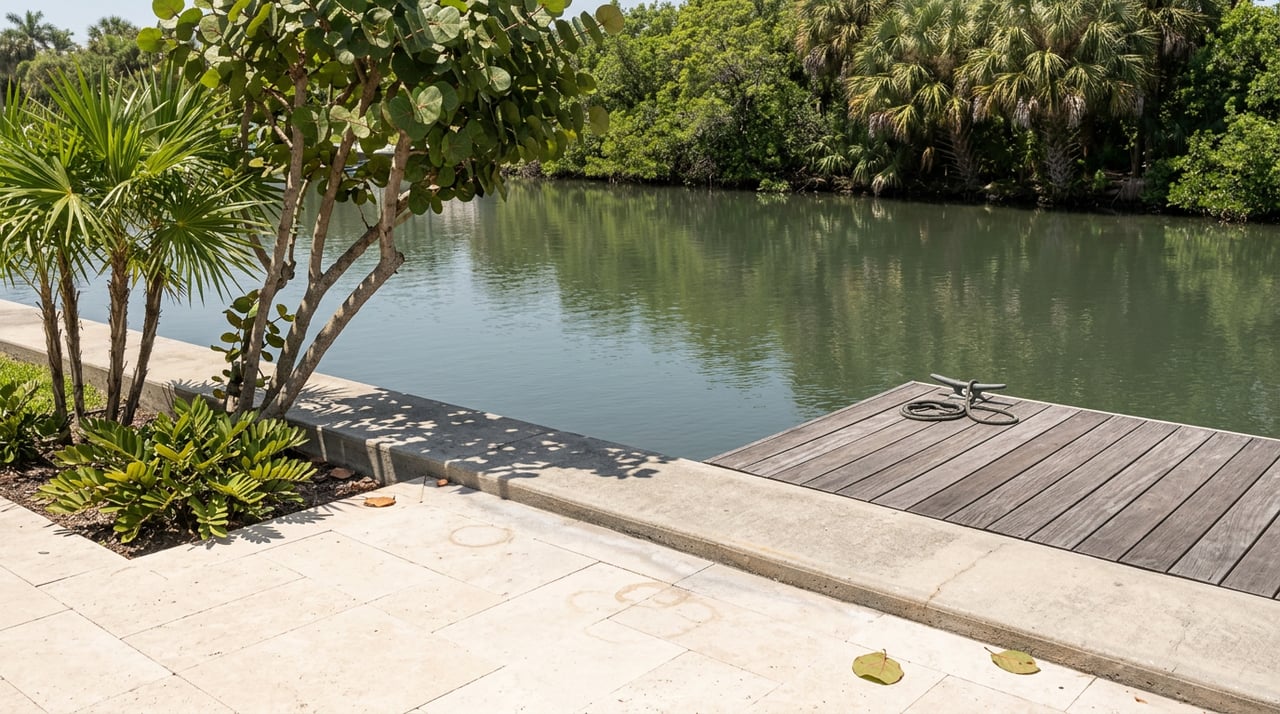
Ask a Park Shore homeowner who is responsible for the seawall behind their property, and most will give you the same answer: they are. That is the standard in Naples. A concrete or vinyl wall holding back Venetian Bay or a canal is treated like a roof or a driveway, a private structure that comes with private upkeep and private cost when it fails.
For most of Park Shore, that assumption holds. But for a stretch of shoreline along Gulf Shore Boulevard North, it does not, and the reason is a 2021 court ruling that most buyers and more than a few agents have never heard of. If you are shopping a waterfront listing in this neighborhood, or preparing to sell one, knowing which category your seawall falls into changes what you should ask for before you sign anything.
Two Regimes, One Neighborhood
In May 2021, the Circuit Court of the 20th Judicial Circuit in Collier County ruled that the City of Naples, not individual property owners, owns and bears the obligation to maintain the seawalls along the Gulf Shore Boulevard North right of way. That stretch had been dedicated by plat to Collier County and later the City. The ruling covers a specific, mapped footprint: roughly 3,300 linear feet of seawall abutting Outlots A through F, including Parcel C.
The case grew out of real damage. A companion settlement agreement from May 2021 released the parties from further claims related to the litigation, with one carve-out: a catastrophic failure of the bulging seawall adjacent to the Venetian Bay North Yacht Club in Outlot E. That bulging wall became the focus of the City's initial repair response, ahead of a broader review of the rest of the district.
Everywhere else along Park Shore's canals and bay frontage, the ordinary rule applies. A marine construction firm serving Collier County puts it plainly: the property owner is usually responsible for seawall repair on a Naples canal lot, though HOAs and condo associations can shift that responsibility depending on the deed and governing documents. That distinction matters more in Park Shore than in most Naples neighborhoods, because Park Shore is one of the few places in the city where a court has drawn a hard line between public and private obligation on the same waterway.
What's Happening on Gulf Shore Boulevard North Right Now
The City is not sitting on that 2021 ruling. As of February 2026, the Gulf Shore Association of Condominiums reported that Naples is moving into Phase 2 of a multi-year seawall replacement along Gulf Shore Boulevard North, the same public stretch covered by the court's decision. The City engaged Stantec Consulting Services for design and permitting, and secured a $3.75 million grant from the state to fund a substantial share of the coming construction.
Phase 1 is already finished. That segment began at 4500 Gulf Shore Boulevard North and ran roughly 700 linear feet to the north. Phase 2 is larger: about 1,510 linear feet, starting at the southern property line of the Village Shops, the same retail center at the heart of Park Shore's Village on Venetian Bay, and extending south from there. The project traces back to May 2018, when GSAC representatives first asked Naples City Council to repair or replace the wall after damage from Hurricane Irma.
Alongside the seawall work, the City plans to rebuild the adjacent sidewalk, curbing, parking areas, and landscaping, mirroring what was done during Phase 1.
| Privately owned seawall (most of Park Shore) | City-owned seawall (Outlots A-F, Gulf Shore Blvd N) | |
|---|---|---|
| Who pays for repair or replacement | The property owner, or the condo association per governing documents | The City of Naples, per the 2021 court ruling |
| Who manages permitting | Owner or contractor applies through the City of Naples or Collier County | The City manages design and permitting directly, currently with Stantec Consulting |
| Current status | Condition varies lot by lot; most concrete seawalls in the area are 30 to 50 years old | Phase 2 in design and permitting as of February 2026, covering about 1,510 linear feet |
| What to request before closing | A recent inspection report, permit history, and a condo estoppel certificate if applicable | Confirmation the parcel sits within Outlots A-F, and the construction timeline for the block |
Why This Matters Before You Sign Anything
Florida law has always required sellers to disclose known facts that materially affect a property's value and are not obvious to a buyer, a standard set by the Florida Supreme Court in Johnson v. Davis back in 1985. That duty applies even in an "as is" sale. The standard Florida Realtors disclosure form asks sellers directly whether there have been past or present problems with seawalls or retaining walls due to drainage, flooding, or soil movement, which means a seller who knows their wall is bowing or losing soil behind the cap cannot leave that box blank and hope for the best.
What changed recently is how much more that disclosure now covers. A 2024 statute, expanded effective October 1, 2025, requires Florida sellers to complete a separate flood disclosure form, known as FD-1, at or before contract execution. That form requires sellers to state whether the property flooded during their ownership, whether they filed a flood-related insurance claim, and whether they received flood assistance from FEMA or another source. For a canal-front or bay-front Park Shore property, that is no longer a conversation that happens during the inspection period. It happens on paper, before the ink dries on the contract.
For condo buyers along Gulf Shore Boulevard North specifically, there is a second layer. An estoppel certificate reveals pending special assessments, and if the building's underlying seawall sits inside the City's Outlot A-F footprint, that assessment risk shifts away from the association and onto the City's capital budget instead. Knowing which regime applies before you request the estoppel tells you what kind of answer to expect.
What a Seawall's Age Actually Tells You
Park Shore's waterways are not natural. The neighborhood was built by dredging and filling to create what is now Venetian Bay, and miles of seawall went in during that original construction decades ago. That history matters for anyone evaluating a listing today, because concrete seawalls in Naples typically last 30 to 50 years with regular care, and marine contractors working across Collier County note that many area seawalls, private and public alike, have already reached or exceeded that life expectancy.
A wall reaching the end of its expected life is not automatically a problem. Contractors report that a targeted repair, addressing tieback failure or soil washout behind the cap rather than a full teardown, can often buy another 20 to 30 years at a fraction of replacement cost. The issue is knowing which situation you are in before you make an offer or set a list price, not after.
There is also a paperwork trail worth checking regardless of who owns the wall. Naples requires engineered plans from a licensed professional engineer or registered architect for any seawall permit, and a final survey before the City will issue a Certificate of Completion. If a seawall was repaired or replaced in the last several years, that documentation should exist and should be part of what a buyer's agent requests.
Condo owners have one more date to watch. The City of Naples has mailed Notice of Required Milestone Inspection letters, with reports due in November 2026 based on each notice's mailing date. For buildings along Gulf Shore Boulevard North, that inspection cycle runs on a separate but related track from the seawall work happening just outside, and a building's Milestone Inspection report is worth requesting alongside any seawall or dock documentation.
Before You List, or Make an Offer
- Confirm whether the parcel falls within Outlots A through F along Gulf Shore Boulevard North. This determines whether the seawall is a private asset or a City-maintained structure under the 2021 ruling.
- Request the most recent seawall inspection report, including any findings on tiebacks, weep holes, or soil loss behind the cap.
- For condos, request the estoppel certificate and ask specifically whether any seawall or dock assessment is pending or anticipated.
- Ask for permit history on any prior seawall or dock repair, including the engineer of record and final survey.
- If buying or selling a unit along Gulf Shore Boulevard North, ask where the property sits relative to the Phase 2 project boundary, since design and permitting were advancing as of early 2026.
A Question Worth Asking Twice
The instinct in Naples is to assume the seawall behind a property is the owner's problem and the owner's cost. In most of the city, and most of Park Shore, that instinct is correct. But a stretch of the neighborhood's most visible shoreline runs on a different rule entirely, one written into a court order rather than a deed. A buyer who assumes private ownership everywhere may be pricing in a repair cost that was never theirs to carry. A seller who assumes the same may be leaving money, or a stronger negotiating position, on the table.
Knowing which rule applies to a specific address is not a detail. It is the first question.
For guidance on a specific Park Shore address, including how it relates to the current Gulf Shore Boulevard North seawall project and what documentation to gather before listing or making an offer, The Kim Price Group offers a private consultation grounded in exactly this kind of neighborhood-level detail.
Frequently Asked Questions
Does selling a property "as is" let a seller skip seawall disclosure? No. Florida's disclosure duty under Johnson v. Davis applies even when a sale is structured as "as is." A seller who knows about a seawall problem still has to disclose it.
How do I find out if a specific Park Shore property falls within the City-owned seawall footprint? The City of Naples maintains project records for the Gulf Shore Boulevard North seawall on its website, including the outlot boundaries covered by the 2021 court ruling. A title search or survey will also show whether the parcel abuts one of the affected outlots.
How often should a private seawall be inspected before listing a home? Marine contractors serving Collier County generally recommend at least an annual visual inspection, with a more detailed below-waterline check before a sale, so any findings can be documented and shared with a buyer rather than discovered during their own inspection period.